Karhunkierros
Also known as The Bear's Trail · The Bear's Ring
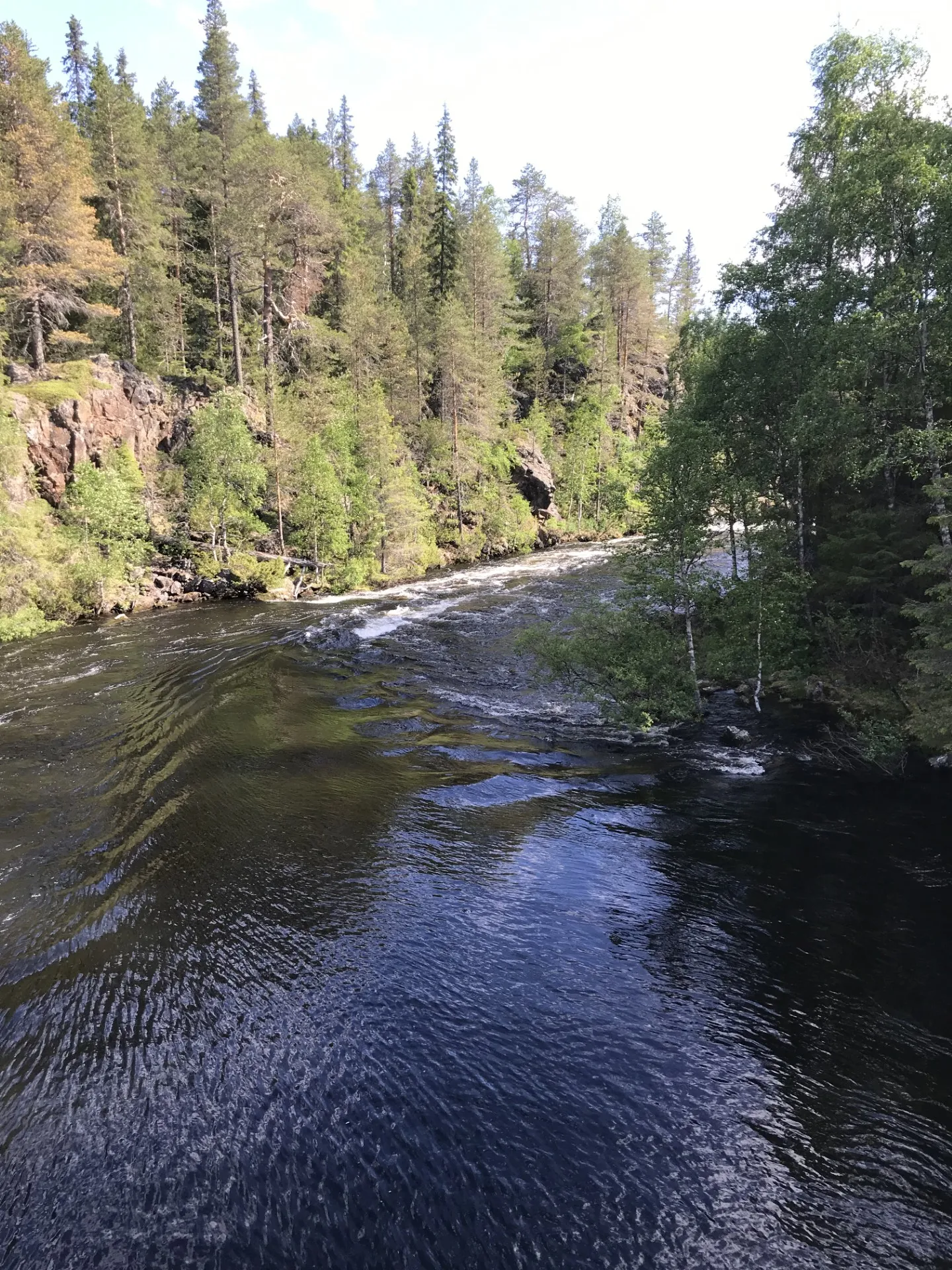
Finland's most famous trail — despite the name "Bear's Ring," it's a linear 82 km route from Hautajärvi through Oulanka National Park to the resort village of Ruka. Expect roaring rapids, river canyons, nine swing-bridges over gorges, old-growth forest and long, meditative stretches where the only sound is the soft forest floor underfoot. Bears use their superb sense of smell to steer well clear of people, so a sighting is extremely rare.
Getting to the trailhead
Fly from Helsinki to Kuusamo airport (direct connections). Ruka resort is about 26 km north of the airport; the northern trailhead at Hautajärvi is further north in Salla.
The trail is point-to-point, so most hikers walk north→south (Hautajärvi→Ruka), which puts the steeper hills near the end. Northern start address: Karhunkierros Visitor Centre / Napapiiri Café, Hautajärventie 414, 98995 Hautajärvi.
The seasonal Karhunkierros Express bus links Kuusamo airport, Ruka, Käylä and Hautajärvi after scheduled Finnair flights (roughly 24 May–30 Sep). A car-transfer service (via Oulangan Taika) can move your car from the start to your finish point. Paid parking at the visitor centre is €10/day.
Plan by season
Temperature
10–20 °C
Daylight
Long days, near-midnight sun in June
Trail condition
Snow-free roughly early June to mid-October; flood season early–late May can inundate parts. Peak season mid-June to end of September.
What to pack
Excellent infrastructure makes this an approachable long trail, but huts fill up and mosquitoes can be intense before mid-August.
Waterproof boots with grip for damp boardwalks and boulder sections
Waterproof shell and a breathable mid-layer
Tent and sleeping bag — open huts are often full in peak season
Mosquito net and repellent (buy before you arrive; trailside shops are pricey)
Power bank — there is no electricity on the trail
Trekking poles for the stair sections and southern hills
Elevation profile — tap a stop
Intermediate km are approximate, reconciled from several sources.
Hautajärvi
Karhunkierros Visitor Centre & Napapiiri Café, Hautajärventie 414. The first ~5 km run outside the park through managed forest.
Good to know
Water
Potable tap at the Oulanka Visitor Centre (year-round). River and natural water along the trail should be boiled or filtered before drinking, especially near busy sites.
Camping
Inside Oulanka National Park and the Valtavaara Nature Reserve, camping is only allowed at designated campsites and beside huts and lean-tos. Everyman's right applies outside those zones. Hammock sleeping is allowed (use tree-friendly straps).
Campfires & toilets
Fireplaces with firewood at huts and lean-tos; check the wildfire warning before lighting one. Plenty of dry toilets — bring your own toilet paper; no wet wipes in composting toilets.
Waste
No bins. Carry everything out. Three recycling/eco-points along the route (Juuma, Oulanka camping) take glass, metal and hazardous waste such as batteries; paper and card can be burned at campfire sites, biowaste goes in dry toilets.
Mobile signal
Mobile coverage is limited and unreliable inside Oulanka National Park, with better signal near Ruka and the visitor centres.
Trail markings
Orange paint blazes and metal signs mark the trail, with distance poles every kilometre — easy to follow. Movement restrictions apply in the Juuma area (stay on the marked trail Apr–Dec) and at Päähkänäkallio cliff (access restricted 1 Apr–15 Aug).
Huts & shelters
Six open wilderness huts (sleeping 10–20, first-come-first-served, with a stove, gas cooker, firewood and dry toilet), three day-use huts, and several lean-tos. Open huts can't be reserved, so carry a tent. No running water or meals in huts.
Emergency & winter
112 works across the EU even with low signal. There is no winter maintenance; winter is only for experienced hikers.
Segment by segment
Hautajärvi → Savilampi
~15 kmEasy opening 5 km through managed forest outside the park; watch for metre-tall ant hills. The first lean-to gives a fine view over the Savinajoki, which you follow to Savilampi. A short side-trail leads to Rupakivi Rock, and the Oulanka Canyon loop is a worthwhile detour near the hut.
Savilampi → Taivalköngäs
~4 kmA long, creaking suspension bridge over the river, then pine forest past the wooden "Oulu Province / Kuusamo" gate where Lapland gives way to North Ostrobothnia, arriving at the historic Taivalköngäs hut and its triple swing-bridges over the rapids.
Taivalköngäs → Oulanka Visitor Centre
~12 kmVia the Runsulampi lean-to and the park campground to the visitor centre (café, water), then the dramatic red-rock Kiutaköngäs rapids just beyond.
Oulanka VC → Ansakämppä → Jussinkämppä
~11 kmThe river broadens and turns sandy at Ansakämppä, then the trail leaves the water and climbs gently toward the midpoint and the lakeside Jussinkämppä hut.
Jussinkämppä → Siilastupa
~10 kmReaches the Kitkajoki and follows it upstream through a sometimes-narrow valley into the popular Pieni Karhunkierros day-loop area; a long swing-bridge and a climb high above the canyon lead to Siilastupa, overlooking the Jyrävä waterfall.
Siilastupa → Ruka
~30 kmThe most demanding stretch: four hills (Konttainen, Valtavaara and others) with steep sections and the best views of the trail, descending finally to the resort village of Ruka.